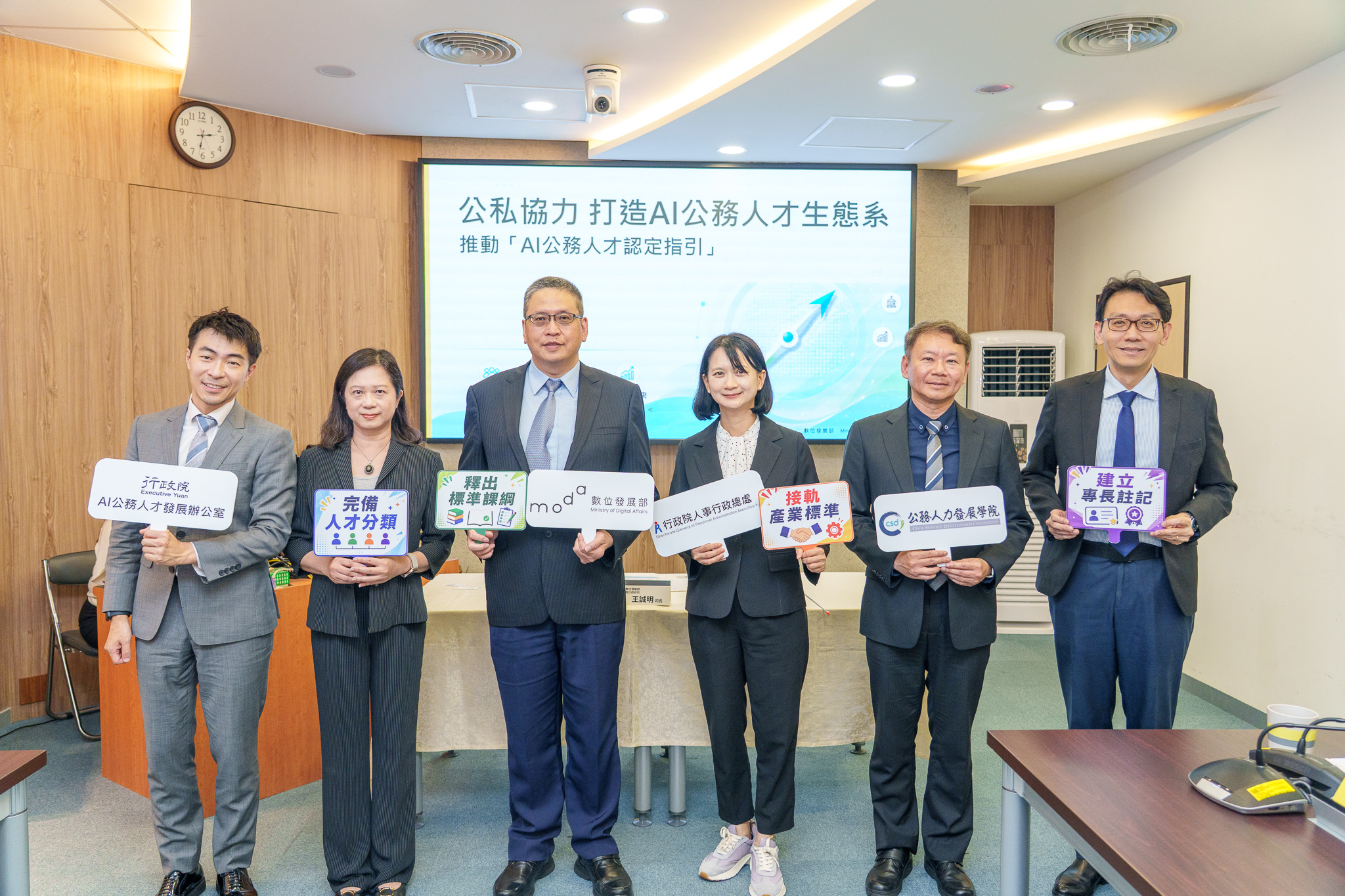
MODA and DGPA Release Beta “AI Government Talent Recognition Guidelines” to Foster an AI Government Talent Ecosystem Through Public-Private Partnerships
In response to the rapid development of AI technology, the Directorate-General of Personnel Administration (DGPA) and the Ministry of Digital Affairs (MODA) of the Executive Yuan launched an AI talent office in July 2025. The goal of this initiative is to coordinate training resources and equip civil servants with strong AI literacy, thereby improving the efficiency of government services through the use of technological tools. Today (9th), DGPA and MODA officially released the Beta version of the “AI Government Talent Recognition Guidelines,” jointly formulated by the two agencies. The guidelines cover the curriculum and development pathways for three talent categories: policy, application, and development. These pathways also incorporate certification mechanisms for the industry to strengthen civil servants’ incentives for promotion by keeping records of their AI expertise. These mechanisms present a framework in which the government creates demand and guides the industry in offering courses, thereby forming a cycle of training, certification, and application. Through this framework, MODA and DGPA aim to build an AI government talent ecosystem where resources are shared and value is co-created.
MODA stated that the formulation of the AI Government Talent Recognition Guidelines is aligned with the framework of the “AI Industry Talent Recognition Guidelines,” developed by MODA’s Administration for Digital Industries. By introducing common industry baselines and integrating existing private sector resources for training and certification into the guidelines, MODA establishes consistent standards between the public and private sectors and a basis for alignment between their AI talent pools. At the same time, the huge training demand from the government can drive the industry to actively invest in AI course development and certification services, thereby expanding the capacity of the overall training ecosystem and forming a symbiotic cycle in public-private partnerships.
MODA further explained that the guidelines feature four core highlights designed to ensure a seamless integration between private resources and government training capacity:
I. Comprehensive Talent Classification for Corresponding Areas of Demand: The guidelines categorize government talent into three main categories, “AI policy talent,” “AI application talent,” and “AI development talent.” These categories clearly define the roles of the civil servants, offering different options for career development.
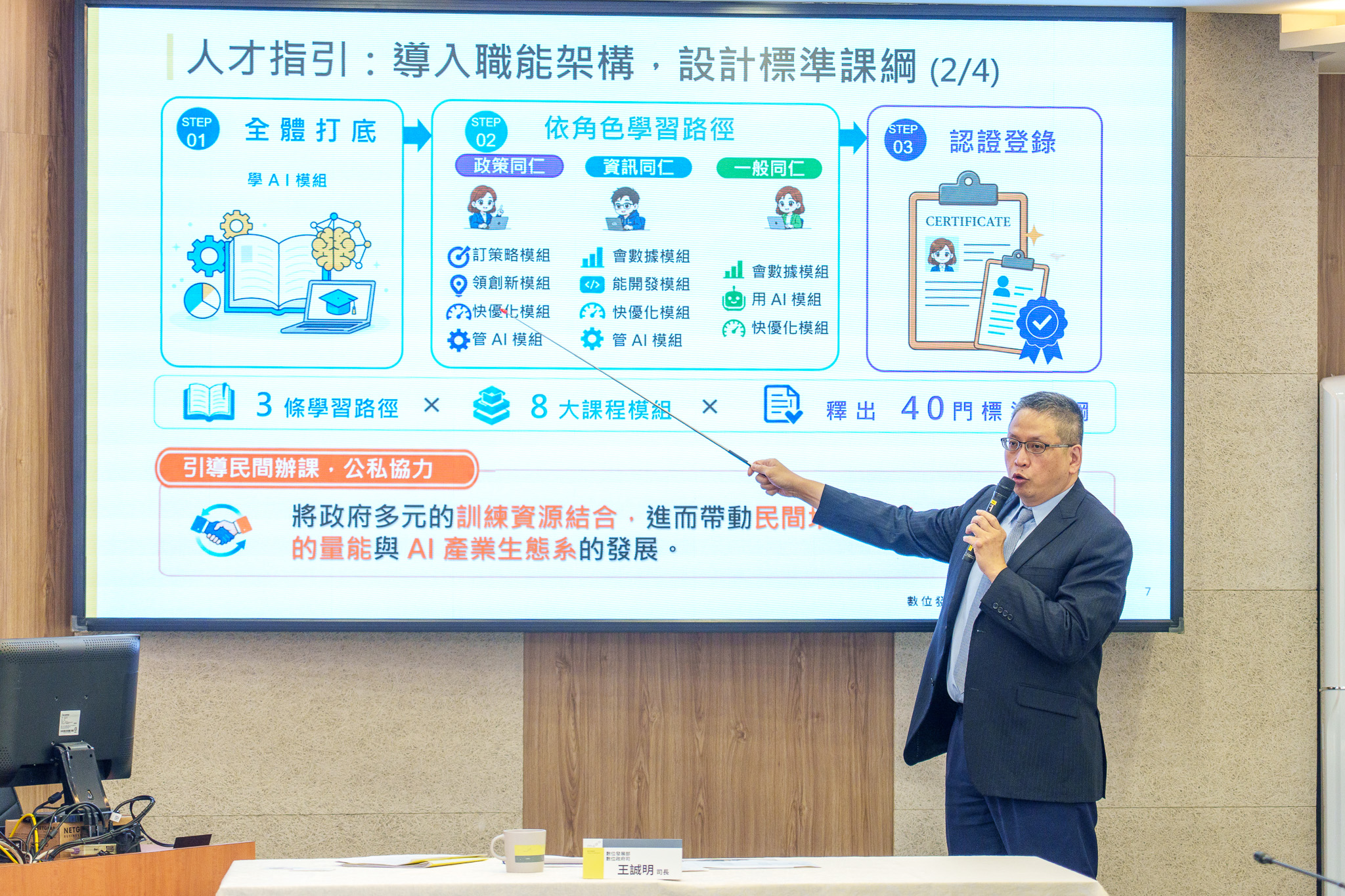
II. Curriculum Guidelines Design That Incorporates a Competency Framework: The guidelines map out three learning paths, eight major modules, and standard outlines for 40 courses, which serve as clear training plans and standards for private training providers to help integrate their resources and offer courses.
III. Integrating Private Sector Resources to Align with Industry Standards: The guidelines implement a “dual-track certification” mechanism. In the initial phase, MODA will directly assess and recognize 25 credible professional certificates from AWS, Google, Microsoft, and the iPAS certification by the Ministry of Economic Affairs. Meanwhile, DGPA will prioritize launching the “Common Core AI Competency Certification for Public Services” in the second half of this year. This certification aims to raise civil servants’ awareness of legal compliance and governance when using AI within the administrative system while improving their capabilities for risk identification.
IV. Establishing Expertise Records to Facilitate Talent Mobility: Civil servants who obtain relevant AI certifications may record their AI expertise in the human resources management information system, which may bring benefits to their promotion opportunities and career development. Furthermore, based on the premise of common AI application competencies, these records can facilitate the mobility of technical talent between the public and private sectors.
MODA and DGPA will conduct a pilot run of the Beta guidelines for six months. Meanwhile, two agencies will continue to make revisions based on feedback from frontline staff in order to make the guidelines better reflect the needs of civil servants and help them incorporate AI into their daily business in a safe and responsible way. For this initiative, MODA and DGPA will continue to proactively gather industry resources from the private sector, creating win-win opportunities in the public-private partnerships.
The “AI Government Talent Recognition Guidelines” are available on this website: https://gov.tw/8b7