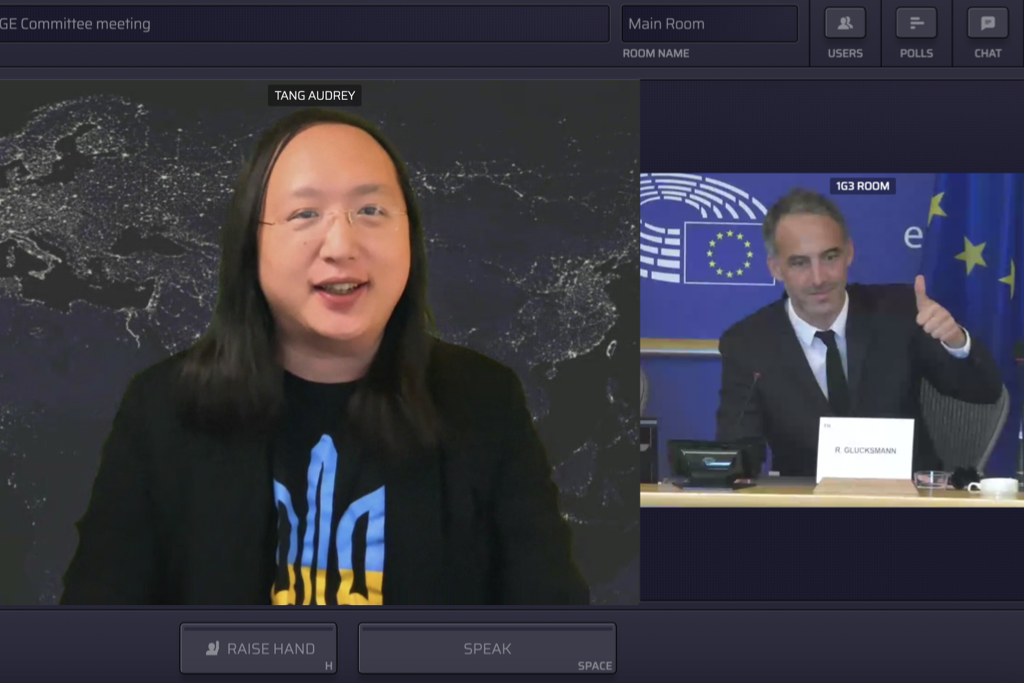
Digital Minister Wears a Symbol Supporting Ukraine During a Speech at the European Parliament
On September 30, the Minister of Digital Affairs, Audrey Tang, spoke via a video call at the European Parliament’s (EP) Special Committee on Foreign Interference in All Democratic Processes in the European Union, Including Disinformation(ING 2). Wearing a T-shirt featuring the Ukrainian symbol, Tang shared Taiwan’s experience of combating the COVID-19 pandemic with digital tools, and the lessons it has learned from Ukraine on the importance of keeping communications running smoothly in the face of misinformation. This concern has prompted Taiwan to conduct proof of concept for a non-geostationary orbit satellite.
On September 30, Tang was invited to give a keynote speech about Taiwan’s digital anti-pandemic policies at the EP’s ING2. She also took questions from parliamentarians during the session, which lasted approximately one hour.
Tang said in her speech that the pandemic has put enormous pressure on the democratic system. She explained that digital democracy is the most efficient solution to challenges such as the human rights dilemma of having to impose lockdowns for anti-pandemic and public health purposes.
According to Tang, Taiwan is good at leveraging civil technological groups’ innovations; this was exemplified through the 1922 SMS Contact Tracing System, which balanced the public’s desire for privacy and the government’s need to track the spread of COVID. In the face of threats that come with misinformation, civil fact-checking collaboration groups such as “Cofacts” have also demonstrated to the world the possibilities enabled by the public’s collaborative efforts.
She added that putting trust in citizens and allowing them to participate in the decision-making process helps to develop innovative solutions, and this is the principle that the Ministry of Digital Affairs (moda) upholds.
During the Q and A session, members of the EP showed an interest in Tang’s T-shirt with a blue-and-yellow Ukrainian symbol. They also asked what Taiwan had learned from Ukraine’s experience, and how it was responding to threats from outside its borders.
Tang answered that one of the most important lessons for Taiwan was to ensure the operation of video calls with the world; therefore, keeping the internet working as usual is vital. In the event of major incidents such as natural disasters or wars, the whole world needs access to first-hand news, and the ability to deliver accurate, up-to-date information and professionally-written news stories can help to combat misinformation.
Tang said this is why Taiwan must continue to keep its submarine communications cables working, while ensuring that there are diverse means of communication available. Thus, the moda has proposed the “Communication Network Response Resilience” forward-looking plan, which includes the proof of concept program for non-geostationary orbit satellites. This will involve the installation of ground-receiving equipment in around 700 domestic and three overseas locations, in order to confirm the system’s usability for video conferences, network calling, and livestream platforms.
The European Parliament has noticed that foreign influences have been systematically interfering with the EU’s democratic processes in recent years, by taking advantage of Europe’s open society, sabotaging citizens’ trust in the government, and weakening democratic and electoral systems. Hence, in June 2020, the EP established the ad hoc Special Committee on Foreign Interference in All Democratic Processes in the European Union, Including Disinformation (INGE), in order to reinforce responses to threats such as foreign interference and misinformation.
Last year in November, the EU sent an INGE delegation to Taiwan for the first time, which applauded Taiwan’s democratic response to foreign interference and misinformation attacks. During the group’s visit, delegates met with Tang, who had been serving as a minister without portfolio, and conveyed the wish to facilitate more interactions with Taiwan.
The EP’s ad hoc committees usually have one-year terms, which can be extended under the EP’s agreement. After the INGE’s term ended in March 2022, the EP immediately established a new ad hoc committee, ING2, to carry on relevant works.
Members of the EP are elected every five years by EU citizens, whom they represent. Their main duties include passing EU legislation, supervising EU organizations, approving or denying European Commission members’ appointments, and reviewing EU budgets.