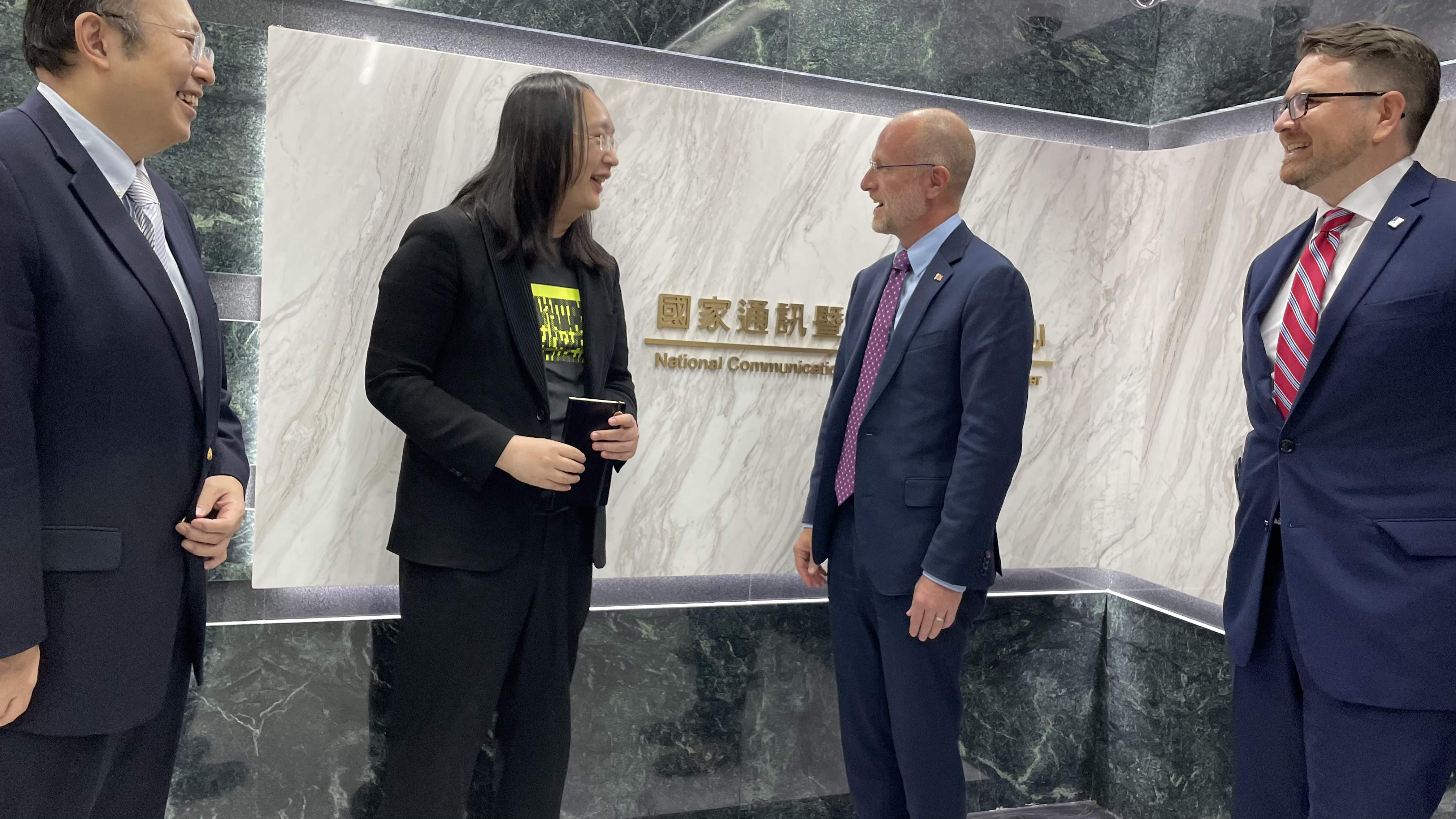
U.S. Federal Communications Commissioner Visits moda, Promotes Cyber Security Exchanges
On November 3, U.S. Federal Communications Commissioner Brendan Carr visited the Ministry of Digital Affairs (moda) Minister Audrey Tang with a representative from the American Institute in Taiwan (AIT). Carr and Tang exchanged views on topics including digital resilience, cyber security, and supply chain security; they reached a preliminary consensus on deepening Taiwan–U.S. collaboration to improve cyber security in telecommunication networks.
During their conversation, Tang said that cyber security-related issues are critical to Taiwan’s national security, due to the country’s geopolitical background. As Taiwan is facing constant cyber-attacks, moda continuously guides the eight fields of critical infrastructure (energy, water resources, telecommunications, transportation, banking and finance, emergency aid and hospitals, central and local governments, and high-tech parks), as well as private enterprises. It aims to enhance their cyber security defense capacities, in order to maintain the country’s normal operation and build a resilient, secure, and reliable “smart country.”
Tang added that Taiwan has also actively built the zero-trust architecture (ZTA) cyber security defense verification environment. Data access is thus “never trusted and is continually verified.”
Under the ZTA, the three key technologies of identity authentication, equipment authentication, and trust extrapolation bypass the cyber security bottleneck presented by the traditional network model. The moda and its Administration for Digital Industries and Administration for Cyber Security have begun implementing the ZTA in different phases, and will actively work with and introduce it to other agencies.
Carr also raised the issue of cross-border data transfer, to which Tang responded by highlighting moda’s current implementation of “local cloud” for government services. The service ensures that data is saved and managed by trustworthy operators at local data centers, and utilizes privacy protection technology. It also works with partners of the Declaration for the Future of the Internet (DFI), to safeguard human rights as a core value while promoting public welfare and innovation.
Additionally, Carr showed high concern regarding the resilience of international communication networks. He said that Taiwan and the U.S. are mutually reliable partners in terms of both economic and national security cooperation, and that he looked forward to the two countries’ close collaboration on deepening cyber security in communication networks.